Work Is Asking You to Be Someone Else
The cultural script said work hard, be decent, and you will be rewarded. The current organization of work systematically rewards the opposite. An essay on the implicative dilemma at the heart of modern professional life.


There is a script most of us were raised on. Work hard. Be honest. Be decent to people. Bring your best. Eventually it will pay off. You will have money, status, security, a sense of having mattered. The system, properly worked, returns what you put in.
Almost nobody who follows this script gets what it promised.
I do not mean that nobody succeeds. People succeed. There are people whose progression matches their effort, whose decency gets rewarded with security, whose impact is recognized in proportion to the impact itself. These people are increasingly rare. What is much more common is the inverse pattern. The people who get ahead are the ones who can move past the script. The ones for whom decency is optional. The ones who can take credit, withhold support, pass blame, present confidently on things they do not fully understand. The ones whose ambition is not constrained by their conscience.
This is an observation about what the current organization of work actually rewards. And it explains, in Kelly's terms, one of the most distressing experiences of modern professional life: the experience of doing what you were taught and finding yourself punished for it.
What work asks of you
Personal Construct Psychology gives us a useful term for what happens here: the implicative dilemma. You have an implicative dilemma when the construct you want to move toward implies a move you do not want to make. "I want to be more assertive" but in your construct system, "assertive" also implies "selfish" or "unkind." Wanting one pole of the first construct forces you onto the undesired pole of the second. The dilemma is structural. You cannot satisfy both at once.
Modern work hands most thoughtful people an implicative dilemma the moment they enter it.
You arrive with a set of core constructs you have built and inherited. Be honest. Be kind. Treat people fairly. Do not take credit you did not earn. Do not promise what you cannot deliver. Do not punish people for things outside their control. These are the constructs that make you recognizable to yourself. They are what Kelly calls your core role.
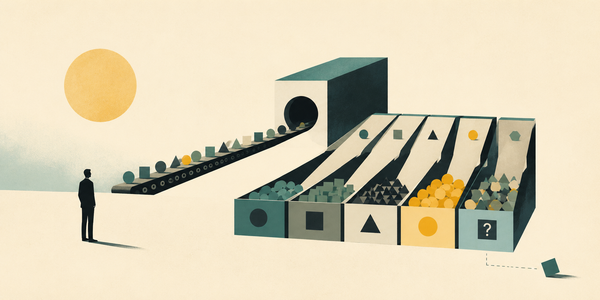
The work environment, as it currently functions, sorts people along a different set of constructs entirely. Aggressive or passive. Strategic or naive. Politically savvy or clueless. Self-promotional or invisible. Career-focused or "not ambitious enough." The system uses different constructs to evaluate you. You must perform against them, or you are sorted to the wrong pole and the consequences accumulate.
If you stay yourself, you get sorted to "not ambitious enough." You are passed over. The promotion goes to the person whose constructs overlap more cleanly with the organization's. You feel the wrongness of it, the misalignment, the way the system fails to register the work you actually did. You burn out, eventually, because every day you are being measured by constructs you do not share, and finding yourself wanting.
If you become the person the system rewards, something else happens. You begin acting in ways that violate your core role. In Kelly's specific use, this is the experience of guilt: the awareness of dislodgement from your core role, of acting as someone you do not recognize. This is one of the most precise and painful phenomena Kelly's framework names. Many people feel it acutely after becoming "successful" in a system whose values they never actually held.
So the dilemma. Stay yourself, watch yourself lose. Become what the system rewards, watch yourself disappear.
The cultural script is part of the trap
What makes this worse is that the script we were raised on insists this dilemma should not exist. We were told work would be a fair exchange of effort for reward. We were told being good people would be recognized, eventually. We were told the system, while imperfect, was broadly meritocratic.
When the dilemma shows up, then, we read it as a personal failure rather than a systemic feature. I must not be working hard enough. I must not be assertive enough. I must not have the right mindset. The story we were given to explain how work works has no slot for "the system rewards traits I was taught were bad." So we look for the problem in ourselves.
This is precisely the move the system needs us to make. As long as the problem is read as individual, it does not have to be solved structurally. You go to therapy, you meditate, you take a productivity course, you try to "set boundaries," you read a book about high performers. These are real responses, and some of them help with adjacent issues. They will not resolve what is structural.
If you are a conscientious person who is exhausted because your conscientious work is being out-competed by someone willing to operate without those constraints, no amount of meditation will fix that. Your stress response is doing exactly what you would expect given the conditions. The problem is the competitive landscape that selects for ruthlessness and renders your traits a disadvantage.
Telling that person they need to "manage their stress better" is a particular kind of cruelty. It locates the failure in the only place that cannot fix it.
The cost to the work itself
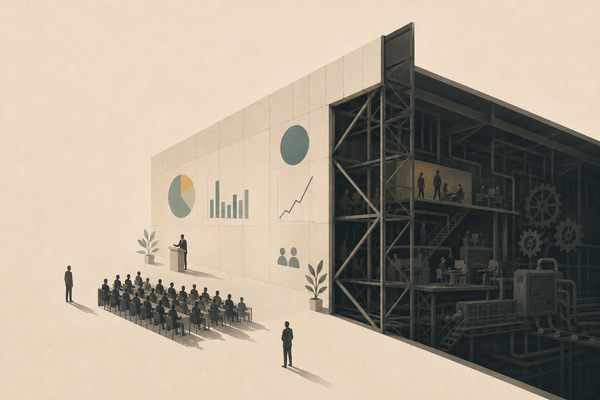
Here is what makes this current arrangement strange even on its own terms. The traits the system rewards (narrow ambition, low empathy, willingness to manipulate, comfort with self-promotion) are not the traits that actually produce good work. They are the traits that produce good appearances of work. They get promoted.
The work itself, the substance of what organizations actually produce, depends on a different set of traits. Attention. Care. Honesty about what is not working. Willingness to do unglamorous things. Comfort with being one piece of a larger effort. The people with these traits are the ones currently being out-competed for advancement and increasingly burned out. They are leaving. They are quiet-quitting. They are not bringing what they could bring, because the conditions to bring it have been hollowed out.
The same companies that are demanding innovation, creativity, and risk-taking are creating the exact psychological conditions under which innovation, creativity, and risk-taking become impossible. You cannot be creative when every mistake costs your job. You cannot take risks when AI is publicly framed as your replacement. You cannot care about your work when caring is not the trait the system pays for.
The companies do not understand they are doing this. They believe they are simply running a tight ship. They are taking a hit they will not connect back to its cause for years, if ever.
The AI overlay
What is being added now is a new layer of pressure. People are being asked to integrate AI tools into work that already feels meaning-stripped. "Absorb this" is the implicit demand. Make yourself more productive, more efficient, more leveraged. The framing is empowerment. The felt experience is being asked to participate in your own substitution.
For people whose work was already an implicative dilemma, already a slow violence against their core role, this is not a small additional pressure. It is the question, no longer evadable, of what am I doing here, and who am I doing it as? Many people are noticing they cannot answer either part.
What would actually help
Telling individuals to fix themselves does not solve a structural problem. The problem is the construct system the work environment uses to sort people, and the asymmetry between that construct system and the one most decent people walk in with. That asymmetry is what makes work so heavy right now for so many.
There is no individual exit from a structural condition. But Kelly's framework offers something that individual self-help does not: clarity. You can see the dilemma you are in. You can name the constructs the system is sorting you against. You can notice when you are being asked to dislodge from your core role, and decide whether the trade is worth it. You can stop interpreting the misalignment as your failure.
This will not get you the promotion. It will let you stop hating yourself for not being someone you do not want to be.
That is not nothing. In a labor market currently structured to make us into people we will eventually have to recover from, it might be the most important thing on offer.