
Organizational Gaslighting: When Everyone Knows and Nobody Can Say
Modern company life runs on a public reality everyone in the room knows is not the operative reality. An essay on what Kelly's framework calls hostility, when it comes from institutions rather than people.

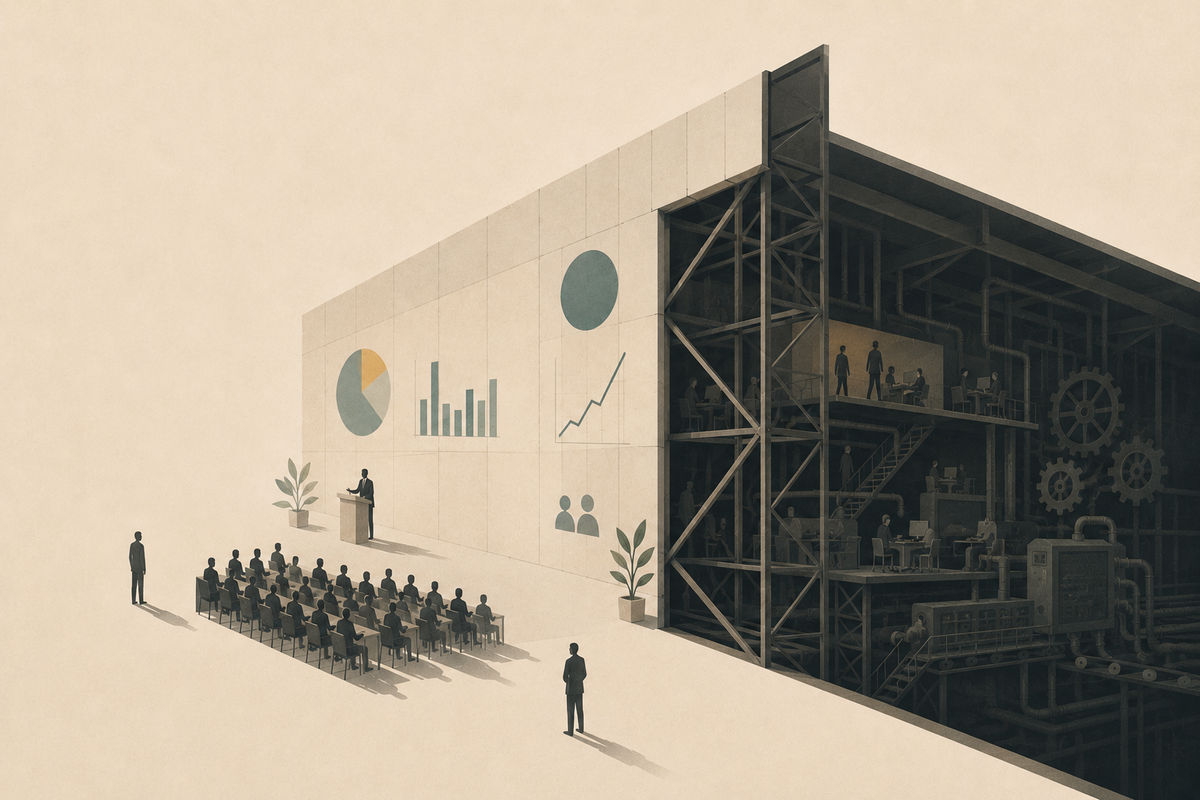
There is a particular quality to the modern company meeting that does not have a clean name yet. The CEO presents the quarterly results. The Chief People Officer talks about engagement scores. A slide goes up about the values: integrity, courage, ownership, customer-first. The audience nods. Then everyone goes back to their desks knowing that nine of the people who were in last quarter's all-hands are no longer at the company, knowing that the engagement scores are managed upward through the same process as the sales pipeline, knowing that the values on the slide describe an organization no one in the room actually works in.
This has been called many things. Corporate hypocrisy. Doublespeak. Performative leadership. None of those quite fit. The phenomenon is more particular. It is the institutional production of a public reality that everyone in the room knows is not the operative reality, sustained by a tacit agreement to pretend otherwise. It is George Orwell's doublethink with HR strategy.
What the gap is, and where it came from
Company reality was never meant to match your reality. That mismatch is structural. The company exists to survive and produce value for capital. You exist to live a life that matters to you. These two purposes overlap for some period each day, but they are not the same purpose. Pretending they are has always been a fiction. What has changed is the texture of the fiction.
The fiction we currently inhabit was built for a different labor market. Employer branding, the entire apparatus of culture decks and career pages and "what's it like to work here" videos, emerged when workers had leverage. Educated professionals had choice. Companies had to compete for them. So the institutions developed a vocabulary of belonging. We are not just an employer. We are a culture. We are a family. We are a place where you can do the best work of your life. This vocabulary made sense in a market where the worker had options and needed to be wooed.
That market is not the current market. Layoffs are continuous and at scale. AI is being deployed publicly as a substitute. The asymmetry has flipped. Workers, in most fields, are being filtered rather than wooed. But the vocabulary did not update. The career page still says "join our family." The all-hands still talks about culture. The values still go up on the wall.
The result is that workers spend their days inside an institutional language that was designed for a different power dynamic than the one they are actually in. The friction this produces is what we are here to name.
The new operating logic, in its own words
What the operating logic actually says, if you remove the branding, is something like this. We have a need for output. We will extract as much of it as possible from each unit of labor. We will frame this extraction as opportunity. We will reward those who internalize the framing. We will remove anyone whose cost exceeds their projected contribution. AI is being layered on as both threat and accelerant. Your role is to keep producing while preparing the tool that may, in due course, perform your role at lower cost. You will be told this is exciting. You will be told it is an opportunity to "operate at higher leverage." You will be paid less, in real terms, than the previous generation in your role. You will get benefits, which you should be grateful for. You will exceed your job description, which is now the floor rather than the ceiling. You will be enthusiastic in the all-hands. You will fill out the engagement survey thoughtfully.
You will also know, the entire time, that none of this protects you from the next cost-reduction memo.
Calling this malicious gets the texture wrong. The people running these companies are mostly not cartoonish villains. They are operating an institution whose purpose, under current conditions, requires this arrangement. They do what the institution asks. They mostly do it without examining it, because examining it would not actually change the institutional logic and would only make their own jobs more difficult.
This is the structural point. The gaslighting is not produced by bad actors. It is produced by what companies, as institutions, currently are.
Where Kelly comes in
This is where Personal Construct Psychology gives us a vocabulary the cultural commentary on workism does not have.
Kelly's framework holds that we live inside public construct systems: shared meanings and dimensions for sorting events that cultures, institutions, and groups press onto us. Companies are public construct systems by design. The mission, the values, the engagement language, the strategic narrative are constructs the company is broadcasting and asking employees to internalize. They are not facts about the company, even when they sound like facts.
For the system to work, employees have to use these constructs to sort what they see. This change is "transformation," not chaos. This layoff is "rightsizing," not failure. This new tool is "augmentation," not replacement. When employees adopt these constructs, the institution looks coherent. When they do not, the institution looks like what it actually is: an extractive arrangement wearing a story.
Two things happen psychologically when you work inside a company whose public construct system has drifted decisively from observable reality.
The first is anxiety, in Kelly's specific sense: the awareness that events are falling outside your construct system. You watch a colleague get walked out. The official construct says "performance was not aligned with strategic priorities." Your private construct says "she was the most competent person in her team and they paid more than her replacement will." Both constructs are present. Neither successfully sorts the event. You feel the failure of the prediction engine, which is what Kelly calls anxiety.
The second is hostility, also in Kelly's specific sense, and this is where it gets sharp. Kelly's hostility is the continued effort to extort validation for a prediction that has already failed. The company keeps running engagement surveys. The engagement keeps being lower than reported. The survey results keep being presented as evidence the strategy is working. The institution is extorting evidence for a story that the workforce, in private, has already invalidated. This is the structural shape of hostility as Kelly defined it, not a metaphor for it.
If you are the employee, your private construct system is increasingly accurate and increasingly punished. If you speak from your private constructs, you are "not aligned." If you perform the public ones, you become someone who routinely says things you do not believe in front of people you know do not believe them either.
This is the gaslighting. It is what makes long days at work so exhausting in a way that the work itself does not explain. The exhaustion is the cost of holding two construct systems at once.
What it costs
The cost to individuals is what we have been discussing across the previous essays: implicative dilemma, dislodgement from core role, the slow erosion of trust in your own perception. The cost is real and it falls disproportionately on people whose core constructs include honesty and accurate sense-making. They are the ones who notice the gap most acutely.
The cost to organizations is also real, even though management mostly cannot see it. The traits that allow people to thrive in a doublethink environment are not the traits that produce careful work. The people who can hold two contradictory beliefs simultaneously and present confidently on both are not, on the whole, the people who notice the actual problem in the system. Companies that select for this trait increasingly find themselves run by people who cannot tell them the truth, because telling the truth was selected against. By the time leadership wants honest information, the population capable of providing it has been quietly trained to provide something else, or has left.
The companies are not aware they are doing this. They will pay for it later, in slow structural ways that are hard to attribute back to the cause. The trade is currently invisible to them.
What gets you free
Nothing, exactly. There is no individual exit from a structural condition. You cannot meditate your way out of an environment that systematically rewards the suppression of accurate perception.
What Kelly offers is the same thing he offered in the earlier essays: clarity. You can see what is happening. You can name the structure precisely. You can notice when the institution is asking you to adopt a construct that does not match what you are observing, and you can decide, deliberately, what to do with that.
Some people will choose to adopt the institutional constructs and become someone who genuinely believes the strategy is working. There is nothing contemptible in this. It is a survival move with real costs and a real basis.
Some people will choose to keep their private constructs intact and perform compliance with the public ones, accepting the steady psychological friction of the gap. This is the most common move. It is exhausting, and most people do not realize they are doing it until they have been doing it for years.
Some people will leave. This is increasingly difficult given the asymmetry of the current market, but it is a real option for some.
The point of naming the structure is that any of these moves becomes more deliberate when you can see what you are inside. The thing the institution most needs from you is that you not see it. The simplest act of refusal is to see it accurately, and to be able to say what it is, at least to yourself.