Train Your Replacement: The New Job Description
The new job description in 2026 is to automate your own role and document it so a model can replace you. An essay on the implicative dilemma at the heart of work in the AI moment, and the identity it asks you to dismantle.

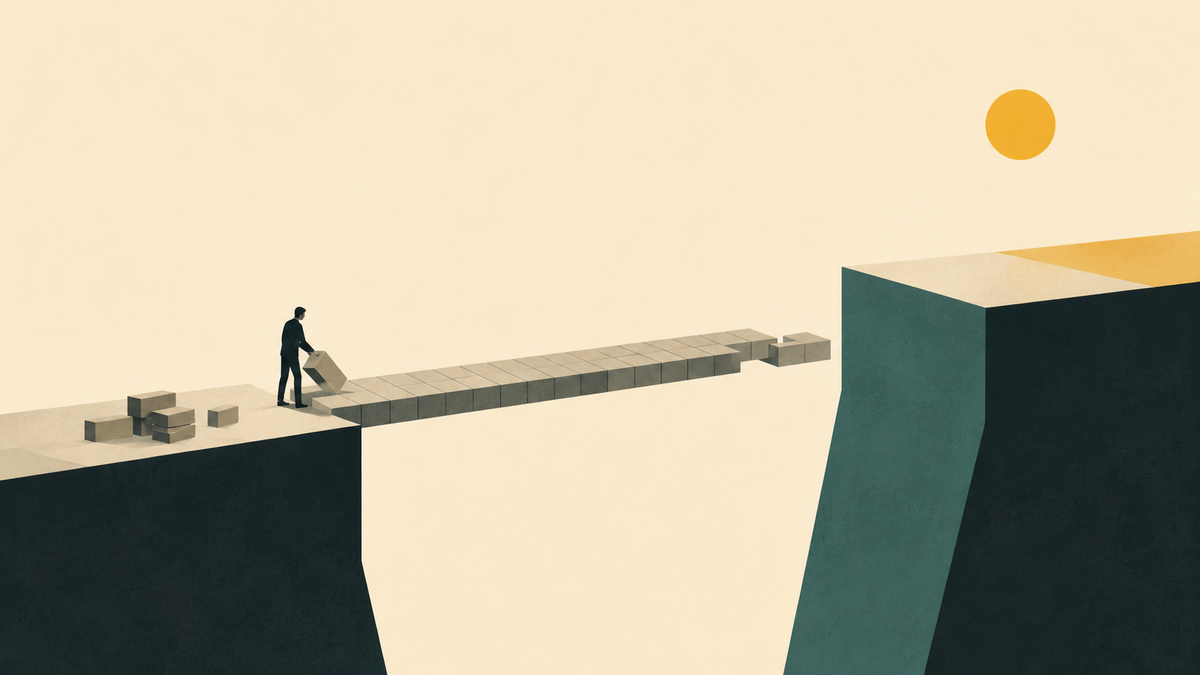
Twenty years ago, the question "do you use AI at work" would not have been intelligible. Five years ago, it meant something like "do you use ChatGPT to draft emails." Today, it means something else entirely. It means: have you automated parts of your role yet, what tasks have you handed to the model, how much of what you used to do is now happening without you, and can you set up the automations that will handle more.
The question changed because the demand changed. Being "AI literate" has come to mean something different. It means actively transferring your work to a model. The good worker, in 2026, is the one who documents their tasks comprehensively, automates as many as possible, and explains clearly to the model what they were doing so the model can keep doing it. This is the new job description in a meaningful number of roles. It is not subtle. The people running organizations say so out loud, in all-hands meetings and in performance review templates.
What this asks of the worker is unprecedented, and it has a precise shape worth naming.
The dilemma
If you do not do this, you will eventually be let go. The grounds will be that you are not embracing the future, you are not productive enough, you are not adapting fast enough. Your refusal to automate yourself will be read as failure to evolve, and the system will replace you with someone who will.
If you do this, you are doing exactly what makes it possible to let you go. The documentation you produced becomes training data for the system that will perform your work without you. The automations you built handle the tasks you used to be paid for. The skills you transferred to the model are no longer skills the company needs to keep paying you for.
You cannot satisfy both at once. The thing that protects your job in the short term is the thing that erodes it in the medium term. The institution has been clear about this.
What Kelly would call it
Personal Construct Psychology has a term for this. Dennis Hinkle, working within Kelly's framework, named it the implicative dilemma. An implicative dilemma is what you have when moving toward the desired pole of one construct forces a move toward the undesired pole of another. The two desired poles you want to occupy are structurally incompatible. The dilemma has a structural shape. It is your construct system rendering one of your wants impossible to satisfy without sacrificing another.
This is what is happening to professional workers under the current AI deployment. The construct "be a good worker today" requires moves (automate aggressively, document thoroughly, embrace the tool) that force you toward "be obsolete tomorrow." The desired pole of being valuable to the organization implies the undesired pole of being unnecessary to it.
In previous decades, the implicative dilemmas of work were softer. To advance you had to manage upward, which strained your sense of authenticity. To survive the politics you had to play them, which strained your sense of fairness. These dilemmas were real, but they had ambiguity. You could navigate them. There was no proof you were ruining your own future by doing what was asked.
The current dilemma has no ambiguity. The documentation and automation are explicitly meant to produce a system that can replace you. The same person asking you to do it will tell you, in the next breath, that headcount reductions are part of the plan. The implicative dilemma has been pulled out of the subtext and made into the org chart.
What this does to identity
There is a layer underneath the dilemma that most commentary on AI and work misses, and it is the layer where the real damage happens.
Most professional adults inherited a construct system from capitalism that linked who you are to what you do for work. The system trained us, for decades, to find self-worth through career progression. Success was construed as climbing. Confidence accumulated through promotions and salary increases and the visible markers of having moved up. Status was construed against the comparator of your peers and what their roles signaled. Even people who would describe themselves as not particularly career-driven will, if pressed, admit that a significant portion of how they feel about themselves on a given day is downstream of how the work is going. The construct system runs deeper than we like to acknowledge.
This is the construct system most of us are walking around with. It was constructed in us long before we had language to examine it. Our parents handed it down. School reinforced it. The market priced everything in it. By the time we entered work as adults, our constructs about success, worth, ambition, security, and identity were already organized around the central fact that career and self were the same thing seen from two angles.
What the current AI moment is doing is asking the people inside this construct system to actively dismantle the source of it.
You spent fifteen years building expertise. The expertise was construed, by you, as evidence of your value. Now you are being asked to compress that expertise into prompts and documentation so the model can carry it forward without you. The skill you took pride in is the skill you are being asked to transfer. The mastery you built is the mastery you are being asked to give away. And the institution is telling you this is empowerment.
In Kelly's vocabulary, this is threat in the precise sense he used the term. Anxiety in Kelly's terms is about events you cannot sort. Fear is incidental change. Threat is something more specific: the perception that the constructs you use to know who you are are about to be substantially altered, and you are watching it happen.
It also produces what Kelly called guilt: the experience of dislodgement from your core role, of acting in ways that violate your sense of who you are. Most discussions of guilt at work focus on doing something morally wrong. Kelly's definition is different and more interesting. Guilt happens when you act in a way that displaces you from the constructs you use to recognize yourself. If your core construct is "I am a competent contributor who matters," and your daily work is now actively eliminating the conditions under which that construct can keep predicting your life, you are dislodged. You feel it. You may not have language for it yet.
A personal admission
I have spent the last decade building a career inside international companies, including the one I am still at. Whatever I write here applies to me. I have construed myself through professional success. I have measured myself against the markers the system handed me. I have used the role to know who I am. I am writing this from inside the condition. The fact that I am also a psychologist with training in PCP gives me vocabulary for what is happening. It does not give me immunity.
This is worth saying because the genre of corporate critique tends to write from a position of having escaped. The implication is that the writer has figured it out and the reader has not. The truth is most of us have not figured it out. We are inside the construct system that is being asked to dismantle itself. Having vocabulary for it helps. It does not solve it.
What this does to the work
There is one more thing to name, which the companies will eventually feel and currently do not.
People in this position cannot do good work. Not because they are bad workers. Because the conditions to do good work are not present. You cannot care deeply about quality when the more you care, the faster you transfer it to a system that will eliminate your job. You cannot innovate, except in narrow ways the institution will read as you "embracing AI," because real innovation requires sustained engagement that no rational worker would invest in projects they expect to outlast. You cannot bring your full attention to anything when a meaningful portion of your attention is on the question of how to remain employed and what your next role might look like.
The companies asking workers to automate themselves are producing the exact conditions under which the work they need done becomes impossible. The output of the institution will degrade in ways that will not be easy to attribute back to the cause. Decisions will be worse. Products will be thinner. Insight will be more shallow. The companies will assume this is because they have not pushed hard enough on AI adoption. They will respond by pushing harder. The cycle is now in place.
What is left
There is no clean closing here. Naming the structure does not get you out of it. Kelly's framework offers, again, clarity rather than solution. You can see the dilemma you are in. You can name the constructs the institution is asking you to dismantle. You can notice the gap between what the institution says it is asking and what it is actually asking. You can decide, deliberately, how much of yourself to hand over and on what terms.
What you cannot do is opt out of the current arrangement. The conditions are structural. The people running the companies are mostly not malicious. They are operating an institution whose logic, under current conditions, requires this. Naming the structure does not change the structure. It changes whether you can see what is happening to you while it happens.
Most of us will do the work. We will be friendly with AI. We will document our tasks and build the automations and explain to the model what we were doing. We will participate, because of our good work ethics or because the alternative is to refuse and accept the consequences. And we will absorb the slow, comprehensive change to our constructs about who we are at work without quite knowing what to call it.
What I am offering is a name. The thing happening to you has a shape. It is an implicative dilemma the institution has created and is now asking you to live inside. The discomfort you feel is the construct system doing what Kelly's framework predicts under these conditions. It is not a failure to adapt fast enough.
That is the smallest, most honest thing on offer. Calling it freedom would be too much.